Every channel that sells short form reach has a price. The harder question is what you actually paid per 1,000 views once the campaign is over.
Here’s how the four main options compare: paid ads, influencers, UGC and clipping. We run clipping campaigns, so we’ll be upfront about where clipping wins and where another channel is the better tool. For our full pricing, see What Does a Clipping Campaign Cost?
The four channels
Paid ads. You pay TikTok, Instagram or YouTube to show your video to an audience you choose. The reach stops the day the spend stops.
Influencers. You pay a creator a fee to post about you to their audience. The fee is agreed before anyone sees the post.
UGC. You pay creators to make videos that you post on your own pages or run as ads. You’re buying content, not distribution, so reach is a second cost.
Clipping. You fund a budget, and hundreds of clippers post their own edits of your content on their pages. They’re paid only for verified views.
How each one is priced
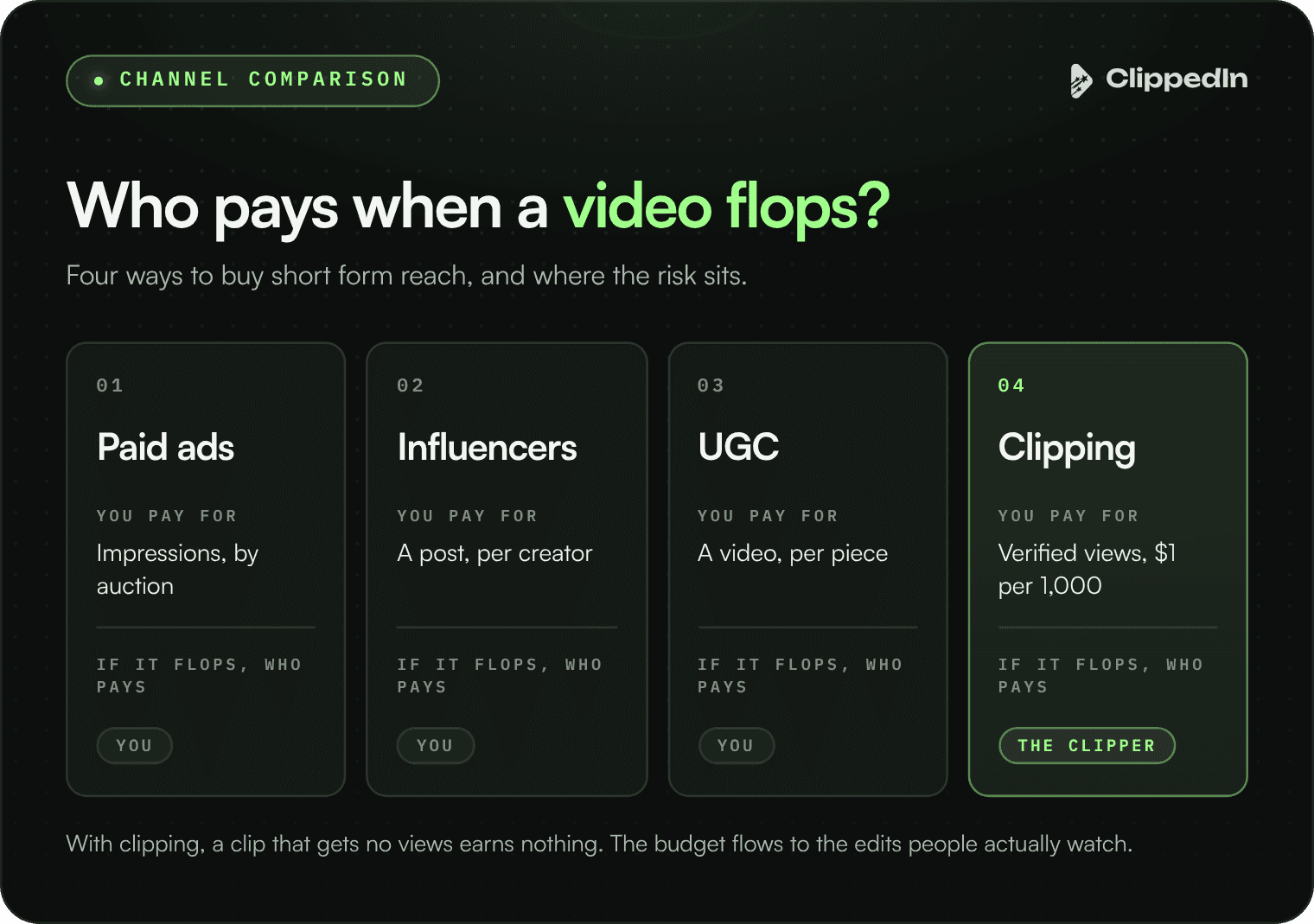
| Channel | What you pay for | Who carries the risk if a video flops |
|---|---|---|
| Paid ads | Impressions, priced by auction | You |
| Influencers | A post, priced per creator | You |
| UGC | A video, priced per piece | You |
| Clipping | Verified views, usually $1 per 1,000 | The clipper |
That last column is the real difference. With ads, influencers and UGC, you pay whether the video works or not. With clipping, a clip that gets no views earns nothing, so the budget flows to the edits people actually watch.
Quoted rate vs what you actually pay
Most channels end up more expensive than the rate you were quoted. Ad auctions get crowded, and a sponsored post can underdeliver. Clipping tends to go the other way, for two reasons.
The cap. Every campaign caps what one clip can earn. When a clip goes viral, the views past the cap cost nothing extra. On our World Cup campaign, the top clip hit 4.2M views and earned the same $200 as a clip at 200,000.
Time. Clips stay up after the budget is paid out, and they keep getting found. Paid ads stop delivering when you stop paying.
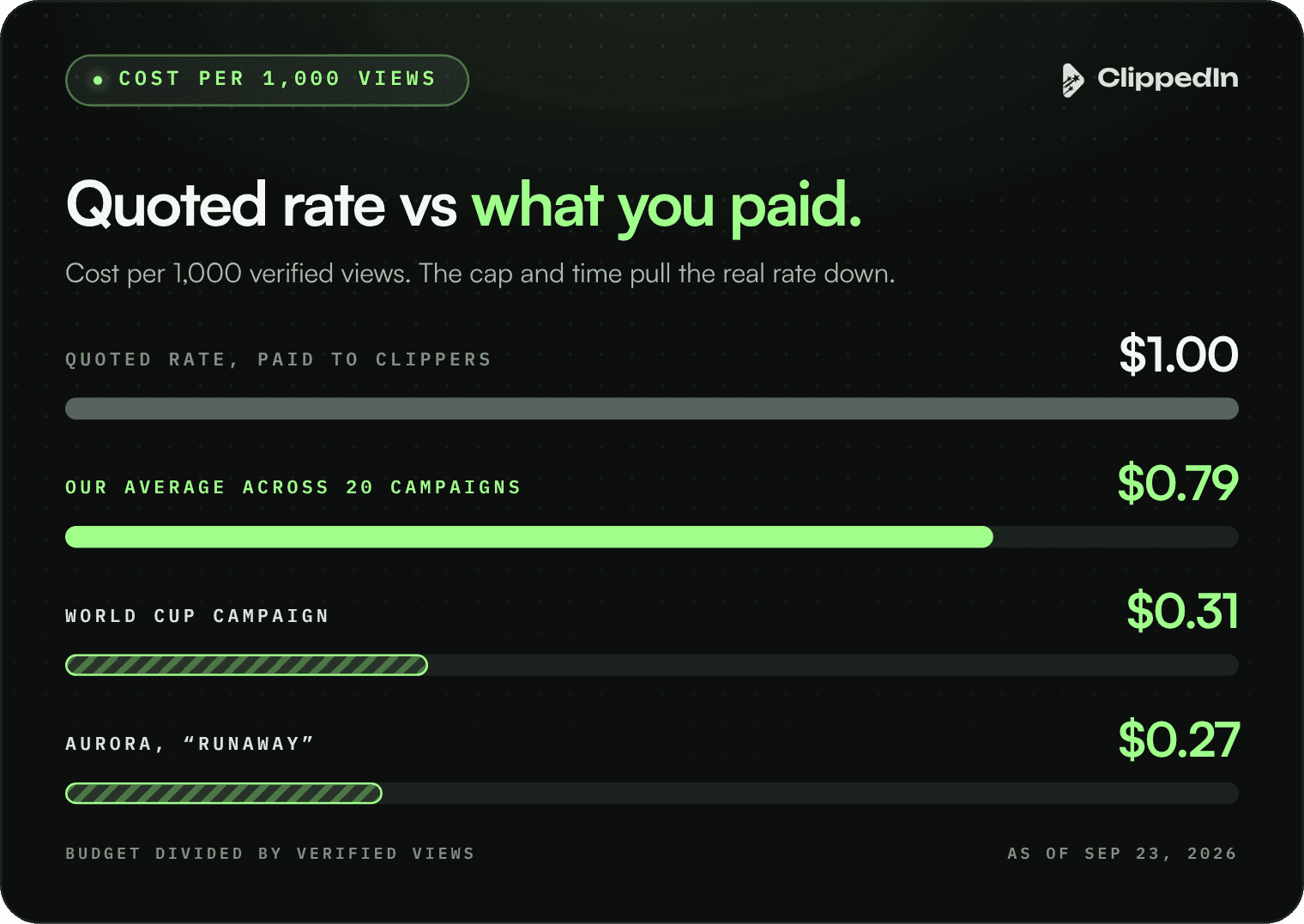
The result: clippers are paid $1 per 1,000 views, but across 20 campaigns our effective rate has averaged $0.79. The World Cup campaign came in at $0.31, and AURORA’s “Runaway” at $0.27.
What each channel does best
No channel does everything. Here’s how we’d use each one.
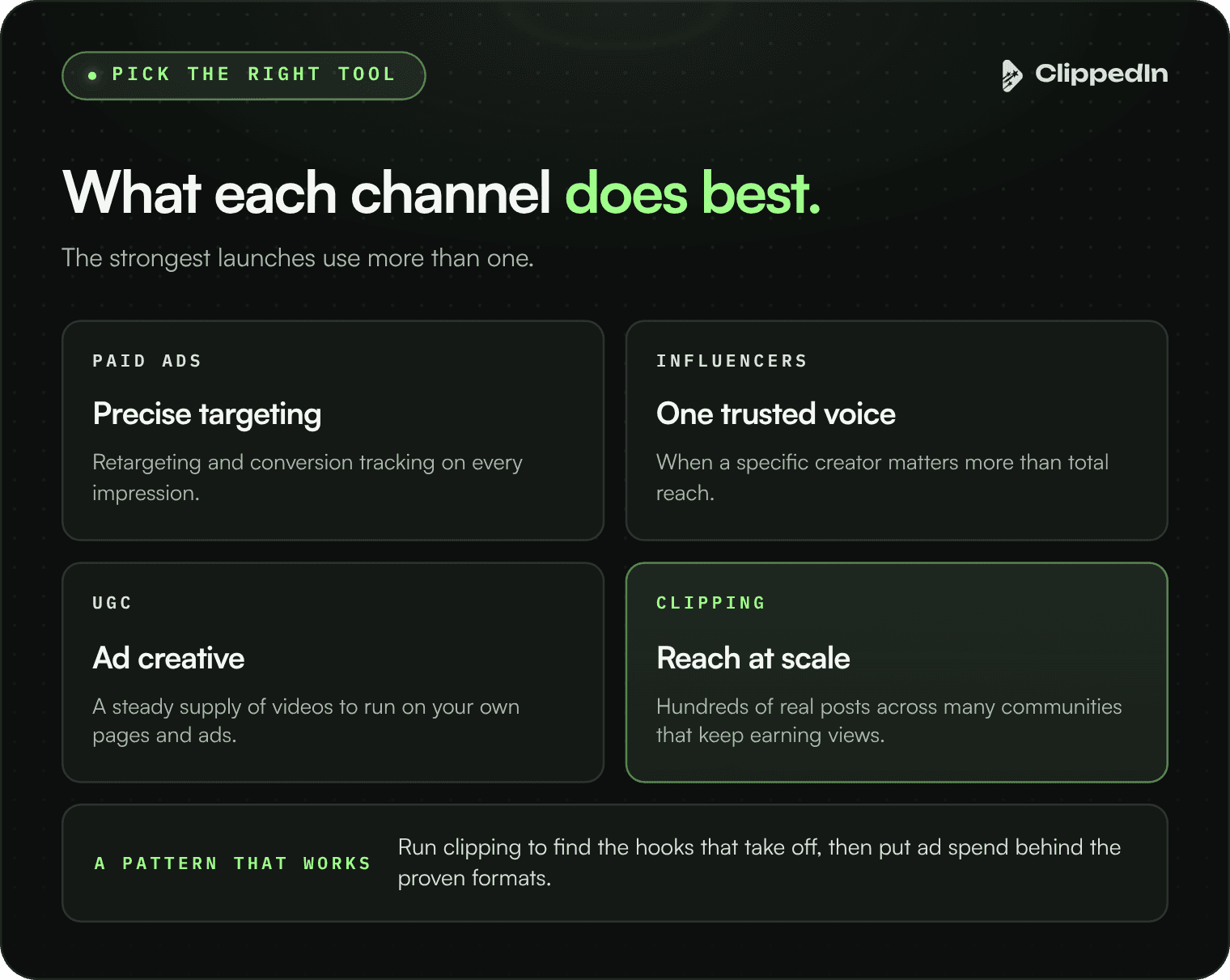
- Paid ads when you need precise targeting, retargeting and conversion tracking.
- Influencers when one trusted voice in a specific community matters more than total reach.
- UGC when you need a steady supply of ad creative.
- Clipping when you need reach at scale across many communities at once, from real posts that keep earning views after the budget runs out.
What clipping doesn’t give you is control over every single post. Clippers work from a brief and we review every clip before it’s paid, but we won’t promise that each one carries a link, a code or a call to action. If you need that on every post, that’s a job for ads or influencers.
Using them together
The strongest launches don’t pick just one. A pattern that works: run clipping to put hundreds of versions of your content into the feed, see which hooks and moments take off, then put ad spend behind the formats that already proved themselves.
The one question to ask
Whatever channel you’re buying, ask this: at the end of the campaign, what did I pay per 1,000 views? Not the quoted rate. The real one.
Across our campaigns, approved clips have passed 100 million verified views. Tell us your budget and what you’re launching, and on a call we’ll show you what it should buy.